I had a 14ga puncture wound last year in Canada, about 1" from my femoral artery. Rapidly flowing blood, tourniquet applied on-scene just below the groin.
Ambulance was on scene quickly, I was immediately put into the trauma center in the ER, stapled, full body CT with contrast, tetanus booster and some more stuff I don’t remember. Time in ER waiting room: zero. Time in hospital: ~1.5 hr total, mostly spent waiting for a follow up outside the ER.
I paid $250 for the ambulance and nothing else. Canada’s healthcare system is GREAT at keeping you alive (if you’re not indigenous, which is a true national shame).
Canada’s healthcare system is not amazing at keeping you healthy. Something minor and chronic? Get fucked, it’s a 2 year wait for a specialist referral. Minorly hurt but not at risk of death? Yeah enjoy the 4-10 hour wait in the ER room. When will you be seen? Idk when we can get to it. Want to see a doctor? Walkin will see you for free in about 45 minutes. Want to see your doctor? Yea they’re out this month working at the hospital, how’s 3 months from now?
All of this is vastly better than my time growing up in the US where the hospital missed diagnosing me with pneumonia and gave me permanent lung scarring. Or missed my fractured ankle on the xray and said I was fine. And then billed my parents 10’s of thousands of dollars.
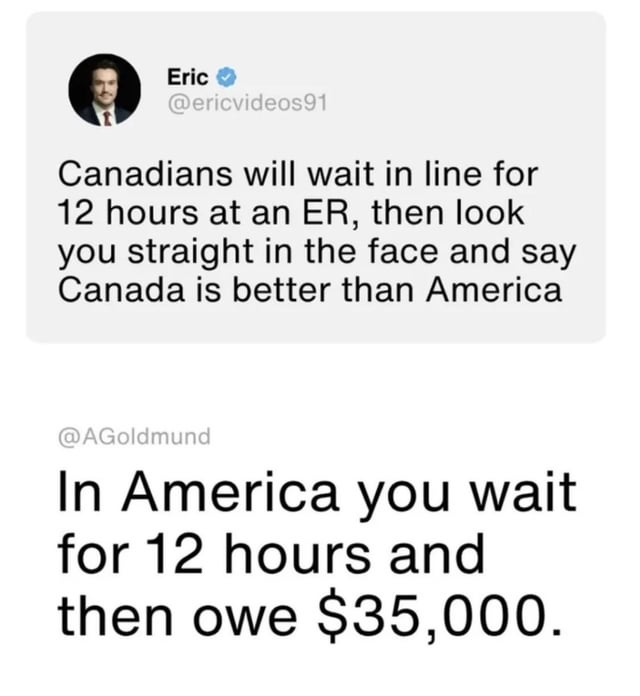
12 hours and $35k? Stop your bullshit. I’ve dealt extensively with healthcare in the US. It’s more like 10 months and $110k.
My partner is literally waiting 10 months to see a rheumatologist for debilitating joint pain. A virtual visit, no less.
Last year my best friend got diagnosed with cancer, and his VA docs let him sit 3 months between appointments. By the time they offered a treatment plan, he had become terminal, almost a year in. He died last June. It’s really quietly horrifying to see it play out in real-time.
My dad got cancer, he was triaged into a special unit right away where they triangulate radiation on a tiny spot in the brain, he got a room to himself for a while, then a chemo regime and limited but helpful home support, and when all that excellent and responsive care didn’t pan out he got hospice that was thoughtful and caring.
No waits. The triage is strong in Canada.
American here. Reluctantly went to the ER because I had been vomiting for a couple of days. Turned out that my gallbladder just stopped working. Was immediately placed into a room, given IV antibiotics, and had surgery the next morning.
Had to stay for 4 days to make sure I was in good shape. The surgery wasn’t super expensive, but the room itself cost me way too much.
Total cost was just over $24k. No insurance (contractor). Even on payments, it’s insane.
My plan is to just never get sick for the rest of my life so I don’t go into another debt hole.
You can haggle with them. Save up a few k and then call them offering to pay a lump sum to settle the debt. A few years ago I broke my wrist and ended up with a 16k bill. I got 3k together, called them, told them I’m poor AF, that they could take the 3k or nothing. They took the 3k.
There’s a horror in having to haggle for the price of your healthcare whilst in the hospital.
Never waited more than 2 hours. I’ve waited longer at a walk-in clinic.
But maybe it’s because I only go when it’s an emergency?
When I went to Econ class, the professor explained that we call it “Free Market Economics” because of four freedoms:
- Freedom of entry and exit - participants (buyers, sellers, and prospective such) can enter or exit the market at their leisure, and the market will not change
- Freedom of participation - every participant is in the market of their free will and can leave the market without repercussion
- Freedom of substitution - every product on a particular market is essentially the same
- Freedom of information - every participant has the same information about availability and prices at the same time
The reward is that free markets are efficient: they lead to the lowest prices and greatest exchange of goods. That is the reason we have them.
When the four freedoms are not mandated, the market fails in different ways, and that’s absolutely expected. When information is available to some before it is to others, we get price distortions - that’s where insider trading laws come from.
Health care, the prof explained, suffers from the fact there is no freedom of participation. You either buy care or you suffer the potentially deadly consequences. That’s why free markets and health care are fundamentally incompatible: they are expected to be.
That “freedom” is a thought experiment that assumes equal resources. Poverty is coercive and undermines the argument. Typical econ.